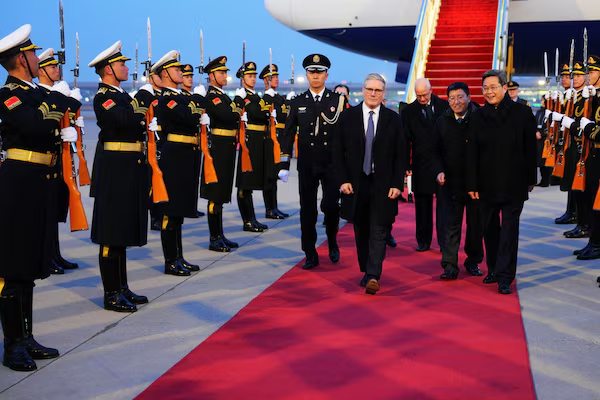
UK Prime Minister Keir Starmer arrived in Beijing on Wednesday for a three-day official visit to China, as Britain seeks to repair strained relations and expand opportunities for British businesses in the world’s second-largest economy.
The visit marks one of the most significant diplomatic engagements between the UK and China in recent years, signalling a shift towards pragmatic engagement after a prolonged period of political tension over trade, security, and human rights concerns.
Downing Street said the trip will focus on economic cooperation, trade access and investment, with Starmer expected to meet senior Chinese leaders and business representatives. The UK government hopes to reopen dialogue on sectors such as green energy, financial services, advanced manufacturing and technology, where British firms are seeking greater market access.
Officials say the Prime Minister will emphasise a balanced approach — promoting economic engagement while maintaining firm positions on national security and values. The visit comes as the UK looks to diversify trade partnerships amid ongoing global economic uncertainty and slowing growth in key markets.
China remains one of Britain’s largest trading partners, but bilateral ties have cooled in recent years following disputes over Hong Kong, technology security and geopolitical alignment. Starmer’s visit is seen as an attempt to stabilise relations without reversing existing safeguards.
Business leaders have welcomed the renewed diplomatic push, saying clearer communication and predictable engagement are critical for companies operating in or trading with China. Analysts note that even modest improvements in ties could unlock significant opportunities for UK exporters and investors.
The Prime Minister is also expected to discuss climate cooperation, global economic stability and regional security issues during his visit. Any agreements or joint statements are likely to focus on practical collaboration rather than sweeping policy changes.
The outcome of the trip will be closely watched by allies and markets alike, as Britain navigates its post-Brexit global strategy and China continues to play a central role in the world economy.