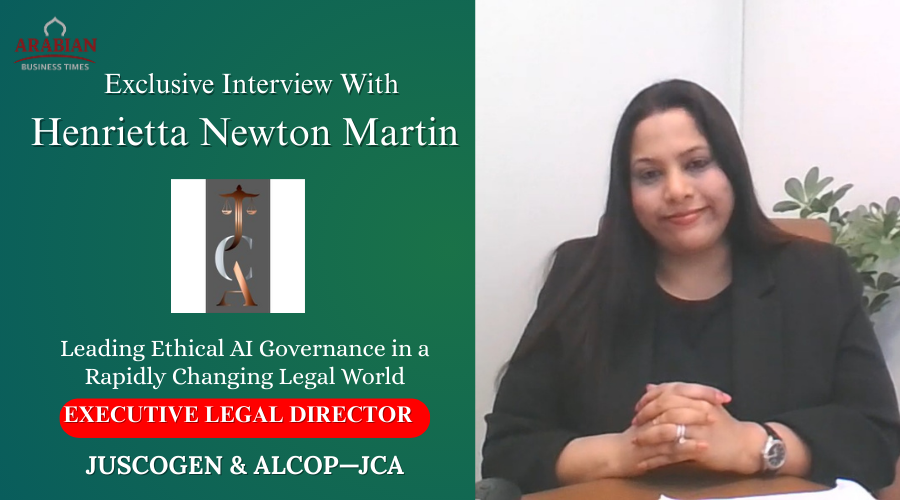
In a world where technology is moving faster than regulation, the role of legal leadership has never been more important. From cross-border corporate strategy to the emerging field of AI governance, modern legal professionals are expected to balance innovation with responsibility.
In this interview, corporate and commercial lawyer Henrietta Newton Martin shares insights from her journey, her approach to helping organizations navigate complex regulatory environments, and her perspective on the future of ethical leadership in a rapidly evolving global landscape.
Amira: Could you tell us about yourself and what inspired your journey into corporate law, AI governance, and cross-border legal strategy?
Henrietta Newton Martin:
My work sits at the intersection of law, leadership, and emerging technology. I am Henrietta Newton Martin, a corporate and commercial lawyer, legal strategist, academic, and author working across jurisdictions.
I began with a strong grounding in constitutional principles, human rights, and commercial law. As businesses expanded globally and technology reshaped decision-making, my practice naturally evolved into cross-border legal strategy and AI governance. I was drawn to this space by the growing gap between innovation and accountability. To me, AI governance is not about limiting progress but ensuring that innovation remains responsible, transparent, and firmly anchored in the rule of law.
Amira: How do you help organizations navigate complex legal, regulatory, and AI-driven challenges while creating measurable business value?
Henrietta Newton Martin:
I work closely with boards, founders, and senior leadership to reposition law as a strategic business function rather than a reactive one. My focus is on aligning legal compliance, regulatory obligations, and AI governance frameworks with commercial objectives and operational realities.
By anticipating risk instead of responding to crises, organizations can reduce regulatory exposure, prevent disputes, strengthen investor confidence, and scale sustainably. My approach is always outcome-driven—transforming legal clarity into commercial certainty.
Amira: What role do you see AI law and ethical governance playing in shaping the future of global business and technology regulation?
Henrietta Newton Martin:
AI law and ethical governance will be central to building global trust in the coming years. As automated systems increasingly influence finance, employment, healthcare, and corporate decision-making, governance frameworks must ensure transparency, accountability, and meaningful human oversight.
Ethical AI governance will soon determine corporate credibility, regulatory acceptance, and market access. Organizations that embed ethics and compliance into the design of their systems will be far better positioned than those that treat governance as an afterthought.
Amira: What are the most critical legal and governance considerations for companies operating across multiple jurisdictions today?
Henrietta Newton Martin:
The most pressing challenges include regulatory fragmentation, data protection conflicts, AI-related liability, sanctions compliance, ESG alignment, and the cross-border enforceability of contracts. In many cases, the real risk lies not in non-compliance but in inconsistency across jurisdictions.
Effective governance today requires harmonized frameworks that respect local laws while maintaining a unified ethical and strategic direction. Consistency, adaptability, and foresight are now essential for organizations operating internationally.
Amira: How does your work as an author, academic, and public speaker contribute to shaping modern legal strategy and leadership thinking?
Henrietta Newton Martin:
My work as an author, academic, and public speaker allows me to engage with law beyond transactions and disputes. It creates space to examine how governance shapes leadership behavior, how ethics influences organizational culture, and how legal strategy must evolve alongside technology and global change.
Writing, in particular, helps me break down complex legal theories into practical, persuasive insights that decision-makers can apply in real-world contexts. Teaching and public speaking foster an ongoing dialogue between theory and practice, while writing allows deeper reflection on responsibility, power, and judgment. Together, these roles help shape principled, future-ready legal leadership.
Amira: What advice would you give to emerging legal leaders looking to build impact-driven, future-ready legal careers?
Henrietta Newton Martin:
Focus on depth before visibility. Master the law, but do not operate in isolation from business, technology, and human dynamics. The most effective legal leaders understand systems, not just statutes.
Equally important is ethical courage; the ability to uphold integrity under pressure. The future of legal leadership will belong to those who combine legal excellence with adaptability, humility, and a strong moral compass. Law is not about control; it is about stewardship and responsibility.
Conclusion
As technology continues to reshape global business, the need for thoughtful, ethical, and strategic legal leadership is becoming increasingly clear. Henrietta Newton Martin’s work reflects a commitment not only to legal excellence but also to responsible innovation and principled governance.
Her perspective serves as a reminder that the future of law lies not simply in regulation but in guiding organizations toward decisions that are sustainable, accountable, and grounded in trust.
Connect with Henrietta Newton Martin on LinkedIn and Instagram