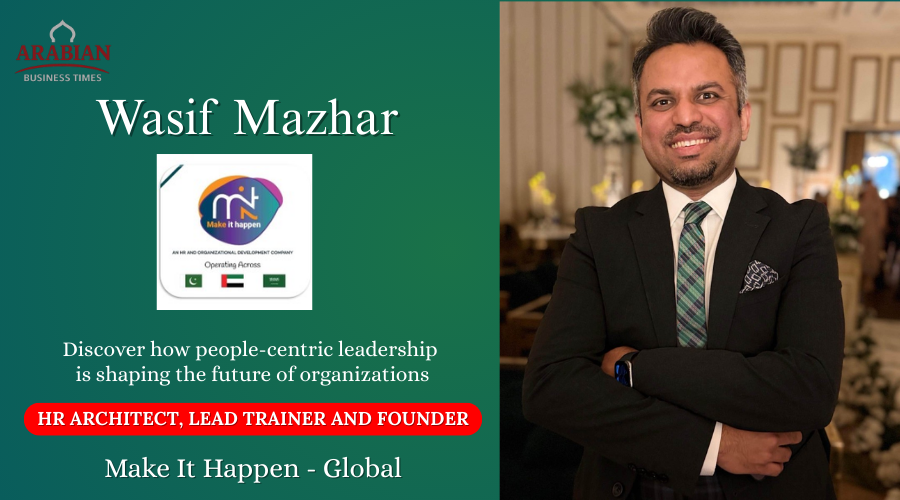
In an era when organizations regularly navigate disruption, growth, and cultural change, leadership rooted in people-centric thinking has never been more critical. Wasif Mazhar, popularly known as Wasif – The Monday Man, stands at the intersection of strategy, leadership, and human transformation. As an HR Architect, Lead Trainer, and Founder of Make It Happen – Global, Wasif has spent over two decades helping organizations across Pakistan, Saudi Arabia, and the UAE build agile, high-performing, and trust-driven workplaces. In this exclusive conversation with Arabian Business Times, he shares insights into his journey, his human-centered philosophy, and how leaders can align purpose with performance in a rapidly transforming business world.
Q1. Your professional identity spans HR Architecture, leadership training, and organizational transformation. How do you personally define your role in today’s evolving business landscape?
Wasif Mazhar:
I see myself as a bridge builder, connecting strategy and people, ambition and execution, and intent and impact. In today’s volatile, fast-moving business environment, organizations don’t fail because of a lack of strategy; they struggle because they fail to activate the people behind that strategy. My role is to architect systems, cultures, and leadership mindsets that make strategy human. Whether I’m working with CEOs, HR leaders, or teams on the ground, my focus remains the same: enabling clarity, alignment, and ownership so that people don’t just work for organizations but work with meaning within them.
Q2. You founded Make It Happen – Global after spending years in leadership roles. What motivated you to leap into entrepreneurship?
Wasif Mazhar:
The motivation came from a growing realization that organizations needed more than traditional HR solutions. I had spent years leading HR, OD, and change initiatives across industries, and while the work was impactful, I felt restrained by traditional structures. I wanted the freedom to design agile, contextual, and people-first solutions without being limited by geography or hierarchy. Entrepreneurship gave me the platform to convert experience into impact, and Make It Happen – Global became the manifestation of that vision, a space where transformation is practical, measurable, and deeply human.
Q3. MIH-Global operates as a GIG-based HR and Organizational Development company. Why did you choose this unconventional model?
Wasif Mazhar:
Because the future of work itself is unconventional, organizations today require flexibility, speed, and specialized expertise without the burden of rigid structures. A GIG-based model allows us to assemble the right minds for the right challenges, ensuring clients receive tailored solutions rather than off-the-shelf frameworks. This model also reflects trust, trust in professionals, trust in collaboration, and trust in outcomes. For me, it was a strategic choice that aligned with how work is evolving globally, particularly in diverse markets such as the MENA region and South Asia.
Q4. You are widely recognized as “The Monday Man.” What does this identity represent, and why Mondays?
Wasif Mazhar:
Mondays symbolize possibility. While many people dread the start of the week, I see it as a fresh opportunity to lead better, learn deeper, and grow stronger. “The Monday Man” is not a brand; it’s a mindset. It represents optimism, resilience, and accountability. Every Monday is a reset button, a chance to show up with intent and energy. Through my content and conversations, I aim to shift how people perceive work, from obligation to opportunity.
Q5. Your HOKA Model has gained attention for aligning human KPIs with organizational OKRs. What inspired its creation?
Wasif Mazhar:
The HOKA Model was born out of frustration, frustration with organizations measuring success through numbers while ignoring the humans producing them. I noticed a persistent disconnect between performance metrics and employee engagement. HOKA, which stands for Human-centric Objectives and Key Alignments, is my response to that gap. It ensures that organizational goals are driven by human behavior, motivation, and capabilities. When people understand how their growth connects to business outcomes, performance becomes sustainable rather than forced.
Q6. With experience across Pakistan, Saudi Arabia, and the UAE, how do cultural dynamics influence your approach to leadership and transformation?
Wasif Mazhar:
Culture is not a challenge, it’s a compass. Every region has its nuances, values, and leadership expectations, and transformation must respect that. What remains universal, however, is the human need for trust, clarity, and purpose. My approach is to localize execution while globalizing intent. You cannot impose transformation; you must co-create it. Understanding cultural context allows me to design interventions that feel authentic rather than imposed, which significantly increases buy-in and long-term impact.
Q7. Leadership and change management are central to your work. What do you believe leaders must unlearn today?
Wasif Mazhar:
Leaders must unlearn control. The era of command and control leadership is over. Today’s workforce values autonomy, transparency, and meaning. Leaders who cling to authority rather than influence risk becoming irrelevant. Unlearning is often harder than learning, but it’s essential. Leaders must shift from managing people to enabling potential. When leaders become facilitators of growth rather than gatekeepers of power, transformation becomes organic.
Q8. Looking back, what challenges shaped you most as a professional and founder?
Wasif Mazhar:
Uncertainty. Starting without a legacy or brand recognition was tough. Convincing organizations to trust a relatively young company required patience and resilience. However, my corporate experience became my credibility. Every challenge forced me to refine my value proposition, sharpen my delivery, and stay grounded. Challenges didn’t break me; they clarified me. They reminded me that growth happens when comfort ends.
Q9. How do you help organizations build agility without compromising structure and accountability?
Wasif Mazhar:
Agility does not mean chaos. It means clarity with flexibility. I help organizations redefine roles, decision rights, and accountability frameworks while encouraging experimentation and learning. Structure should enable speed, not slow it down. When people understand expectations and feel safe to innovate, agility becomes a natural outcome. It’s about balancing discipline with trust.
Q10. What role does trust play in organizational success, and how can leaders actively build it?
Wasif Mazhar:
Trust is the currency of high-performing organizations. Without trust, strategy crumples and culture rots. Leaders build trust by being consistent, transparent, and understanding. Trust grows when words align with actions and when leaders listen without judgment. It’s not built through policies but through daily behavior. Once trust exists, performance follows naturally.
Q11. Many organizations struggle with engagement. What is often misunderstood about employee motivation?
Wasif Mazhar:
Motivation is not universal. What drives one individual may not drive another. Organizations often depend on incentives while ignoring purpose, growth, and recognition. People want to feel valued, heard, and connected to something meaningful. Engagement is not an initiative; it’s a culture. When leaders invest in understanding people, motivation becomes intrinsic rather than forced.
Q12. What advice would you offer to HR leaders aiming to become strategic partners rather than support functions?
Wasif Mazhar:
HR must stop waiting for a seat at the table and start building the table. Strategic HR leaders understand business deeply, speak the language of outcomes, and challenge leadership when necessary. They move beyond processes and policies to architect experiences and capabilities. HR’s future lies in influence, not administration.
Q13. How do you personally define success at this stage of your journey?
Wasif Mazhar:
Success for me is impactful with integrity. It’s about enabling leaders to think differently, organizations to perform better, and individuals to grow confidently. If my work leaves people more empowered than before, I consider it successful. Growth, for me, is not just scale; it’s significance.
Q14. Looking ahead, what is your vision for Make It Happen – Global and the future of work?
Wasif Mazhar:
My vision is to continue building human-centered organizations that thrive in complexity. The future of work demands empathy, adaptability, and continuous learning. MIH-Global will remain a motivation for that transformation, agile, relevant, and impact-driven. As long as organizations believe that people are their greatest strength, there will always be work to be done.
Q15. Finally, what message would you like to share with leaders navigating uncertainty today?
Wasif Mazhar:
Uncertainty is not the enemy; stagnation is. Embrace change, trust people, and lead with purpose. Transformation does not begin with strategy documents; it begins with belief. When leaders believe in people, people believe in possibilities, and that’s where real change happens.
Conclusion
Wasif Mazhar’s journey is a compelling reminder that sustainable business success is not built on processes alone, but on people who believe in the purpose behind their work. Through his experience, the HOKA Model, and his commitment to human-centered leadership, Wasif continues to challenge organizations to rethink how they define performance, engagement, and growth. As businesses across the region adapt to new realities, voices like his offer clarity, inspiration, and a practical roadmap for transformation, one where trust, agility, and human potential drive results. For leaders willing to embrace change and put people at the heart of strategy, the future is full of opportunity, and every Monday is a chance to make it happen.
Connect with Wasif Mazhar on LinkedIn