UAE Launches Ground-Breaking Solar + Battery Project – A New Era for Clean Energy
The Abu Dhabi-based energy ecosystem has embarked on a major renewable energy milestone with the launch of what is being described as the world’s largest integrated solar photovoltaic (PV) and battery-energy-storage (BESS) project. Developed by Abu Dhabi Future Energy Company PJSC – Masdar (“Masdar”) in partnership with Emirates Water and Electricity Company (EWEC), the initiative aims to overcome one of the most persistent challenges facing renewables: intermittent supply.
Project at a Glance
- The project will feature a 5.2 GW solar PV plant coupled with a 19 GWh battery storage system — making it the largest of its kind globally.
- It is designed to deliver about 1 GW of baseload renewable power around the clock. In other words, continuous 24/7 clean power rather than just during daylight hours.
- Operational target: expected to be online in 2027.
- Anticipated environmental impact: Avoiding approximately 5.7 million tonnes of CO₂ annually when fully operational.
- Job creation and industrial impact: More than 10,000 jobs are expected, and new manufacturing facilities will be developed to support scale-up.
Why This Matters
- Baseload renewable power: Traditionally, solar and wind suffer from intermittency — the sun doesn’t always shine, wind doesn’t always blow. By combining a very large solar PV plant with very large battery storage, this project aims to produce reliable power comparable to conventional baseload plants (coal, gas) but without the fossil-fuel emissions.
- Global benchmark: This initiative sets a new standard for large-scale renewable + storage integration. As stated by leadership at Masdar and EWEC, it will act “as a blueprint that can be replicated internationally.”
- Technology & innovation: The project will include modern, advanced capabilities such as grid-forming and black-start functions (i.e., ability to start up the grid independently), AI-enhanced forecasting and intelligent dispatch of power, and virtual power-plant architecture.
- Economic & strategic significance: For the UAE, this aligns with national objectives to diversify its economy, support digital and AI sectors (which require large, dependable power supplies), and raise its global clean-energy leadership profile.
Developer & Stakeholders
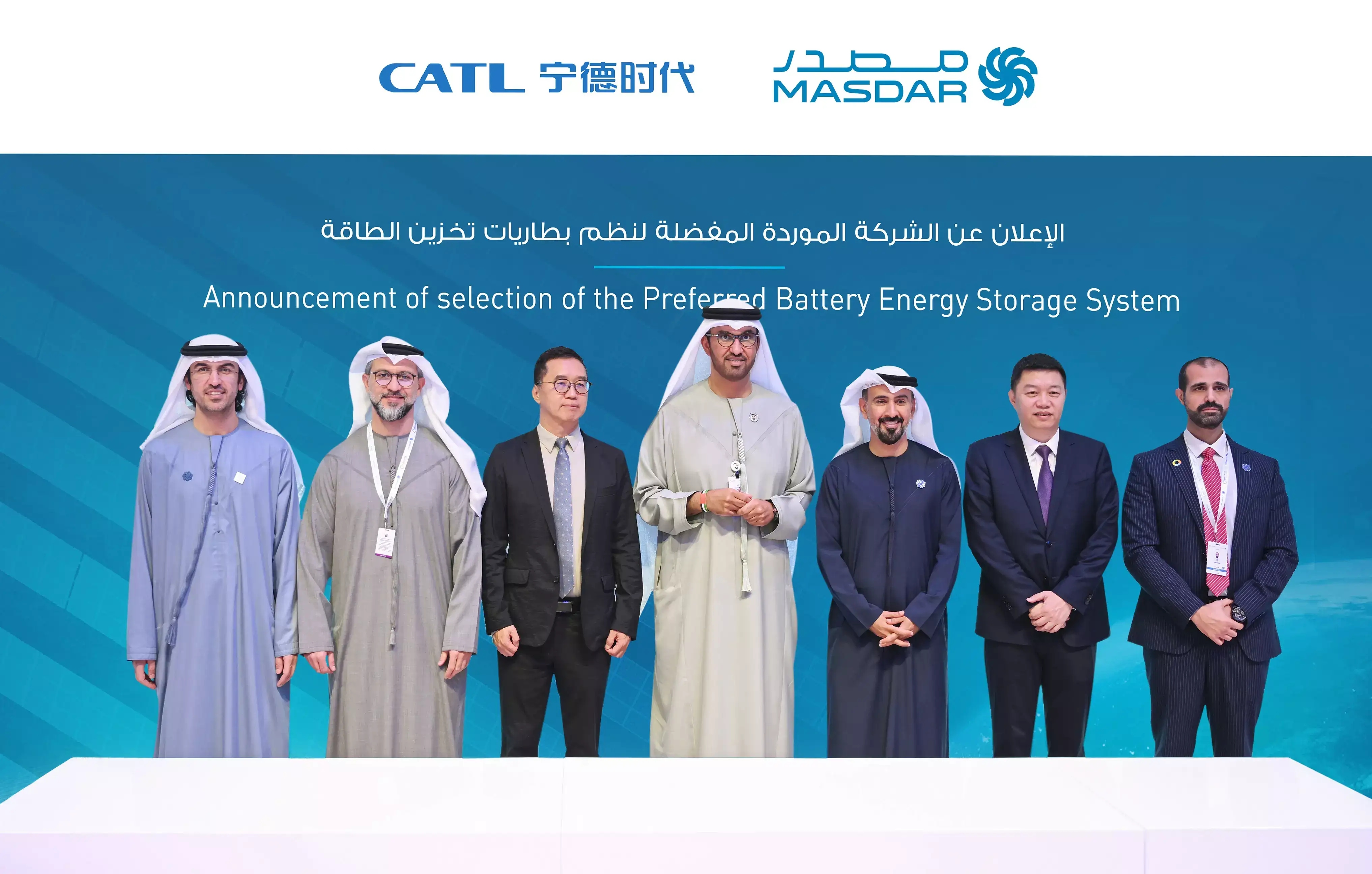
- Masdar (Abu Dhabi Future Energy Company PJSC) is the principal developer, and is already active globally in renewables and storage. It has publicly committed to achieving 100 GW of clean-energy capacity by 2030.
- EWEC (Emirates Water and Electricity Company) is the Abu Dhabi-based utility partner responsible for power & water in the emirate, linking the project to the grid and operational framework.
- The UAE leadership is closely involved: The ground breaking was witnessed by Sheikh Theyab bin Mohamed bin Zayed Al Nahyan, Deputy Chairman of the Presidential Court for Development and Fallen Heroes’ Affairs, reflecting government commitment.
Implications for Business, Tech & Energy Sectors
- Energy industry: This project will influence how utilities and power producers design future renewables-plus-storage systems. It may accelerate the move away from fossil-fuel baseload plants in favour of large-scale storage-coupled renewables.
- Technology sector: The requirement for AI, large-scale battery systems, grid smartness, and high-reliability infrastructure opens opportunities for tech companies, energy-storage vendors, digital control systems, predictive analytics etc.
- Investment & manufacturing: With the scale of investment and manufacturing mentioned, there may be opportunities around battery manufacturing, solar module/plant equipment, grid infrastructure, and services.
- Policy & regulation: Governments and regulators will closely watch how the economics (tariffs, cost of storage) perform — this project may influence how renewable tariffs are structured and how storage is valued within the grid.
- Sustainability & climate goals: For the UAE, but also regionally, this marks a meaningful step toward net-zero and clean-power targets — potentially influencing other countries in the Middle East and beyond.
Key Takeaways for Your Audience
- If your readers are business- or tech-oriented: emphasise the scale, the integration of solar + battery, and the continuous baseload power aspect – which is a shift from earlier renewables projects.
- If readers care about investment: highlight the AED 22 billion capital cost, 10,000 + jobs, manufacturing spin-offs, and how the UAE is positioning itself as a global clean-energy hub.
- If your audience is tech/data-heavy: point out the AI forecasting, grid-forming features, virtual power plant capabilities – this is energy + digital working together.
- If your audience is sustainability-focused: underscore the CO₂ avoidance figure (≈5.7 million tonnes annually) and what this means for large-scale renewables viability.
- For local/regional relevance: show how the UAE is leading in the Middle East region, and how this may influence energy market dynamics (tariffs, energy-intensive industries, data centres).
Suggested Headline & Sub-heading
Headline: UAE Breaks Ground on World’s Largest Solar + Battery Storage Project to Deliver 24/7 Clean Power
Sub-heading: The AED 22 billion initiative in Abu Dhabi will integrate a 5.2 GW solar PV plant with a 19 GWh battery system — a global first in baseload renewable power.