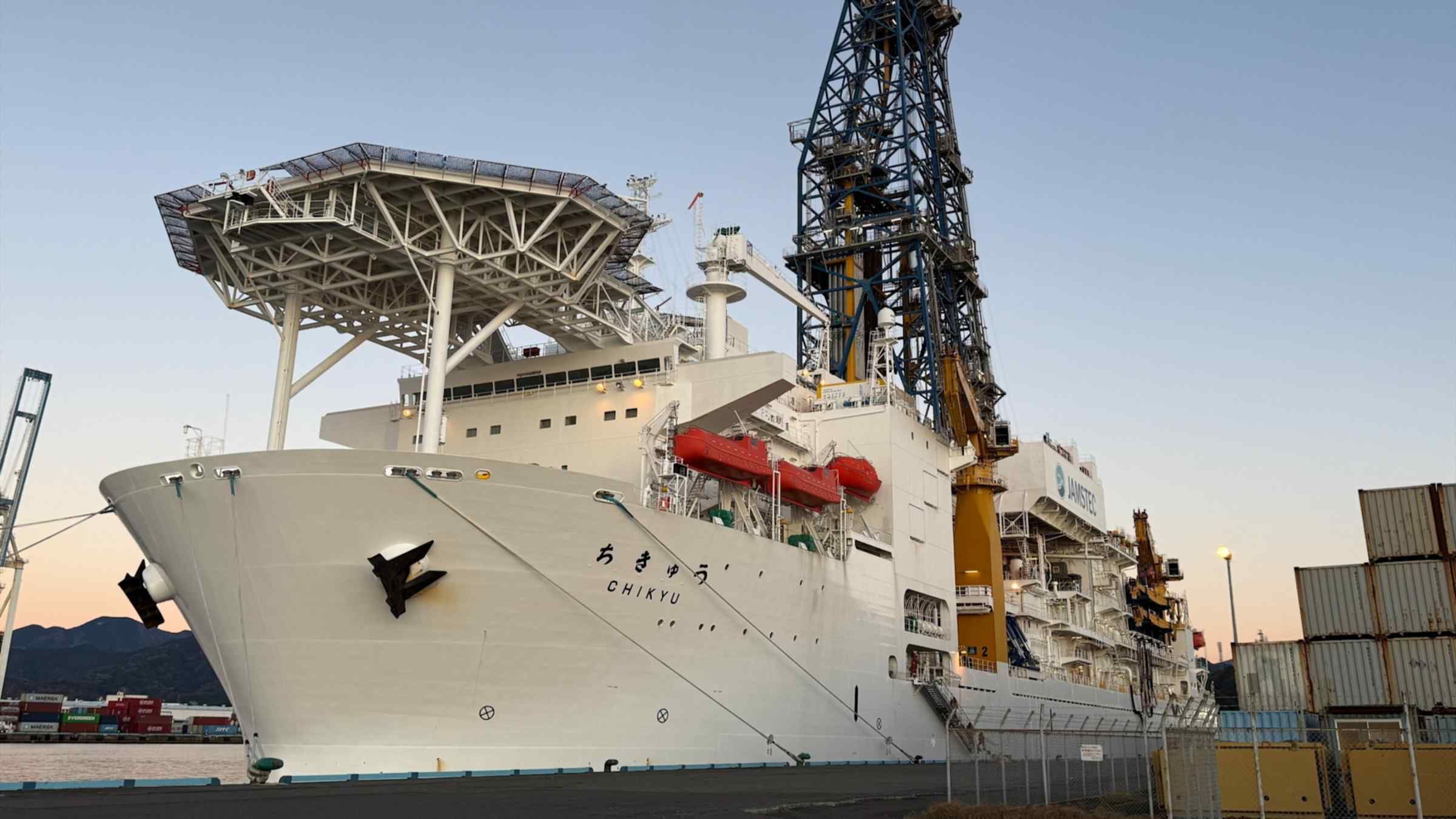
Japan has achieved a world first in deep-sea resource exploration, successfully retrieving rare earth-bearing sediment from almost 6,000 metres beneath the Pacific Ocean, a depth previously considered beyond the reach of practical extraction.
The landmark operation was carried out using Chikyu, Japan’s state-of-the-art deep-sea drilling vessel, operated by the Japan Agency for Marine-Earth Science and Technology (JAMSTEC). The mission marks the deepest successful recovery of rare-earth–rich seabed material ever recorded, opening a new frontier in critical mineral supply.
Why it matters
Rare earth elements (REEs) are essential to modern life. They are used in electric vehicle motors, wind turbines, smartphones, military systems, semiconductors, and renewable energy technologies. Global supply chains are highly concentrated, leaving many countries vulnerable to geopolitical risk and export controls.
Japan, which relies heavily on imports for strategic minerals, sees deep-sea resources as a way to strengthen economic security and reduce dependence on foreign suppliers. Studies suggest that sediment in Japan’s surrounding waters could contain hundreds of years’ worth of rare earth demand, if extraction can be made commercially and environmentally viable.
A technological breakthrough
Operating at nearly 6,000 metres – where pressure exceeds 600 times that at sea level – required major advances in drilling, navigation, and sediment recovery. Chikyu’s success demonstrates that ultra-deep seabed extraction is technically possible, a milestone long viewed as aspirational rather than achievable.
Engineers were able to drill into the ocean floor, retrieve intact sediment cores, and confirm the presence of rare–earth–rich mud, validating years of research and simulation.
Environmental and geopolitical questions
While the breakthrough is being hailed as a scientific and engineering triumph, it also raises serious environmental and regulatory questions. Deep-sea ecosystems are among the least understood on Earth, and scientists warn that large-scale mining could cause irreversible damage to fragile habitats.
International rules governing seabed mining, particularly in international waters, remain under debate. Japan has emphasized that the current recovery is research-focused, with commercial extraction still years away and subject to environmental safeguards.
What comes next
Experts say the success shifts the conversation from “Can it be done?” to “Should it be done, and how?” Japan is expected to continue testing recovery methods, environmental monitoring systems, and cost-efficiency models before any move toward commercial development.
For now, the mission cements Japan’s position at the forefront of deep-sea technology, with implications that could reshape global supply chains, resource geopolitics, and the future of critical minerals.