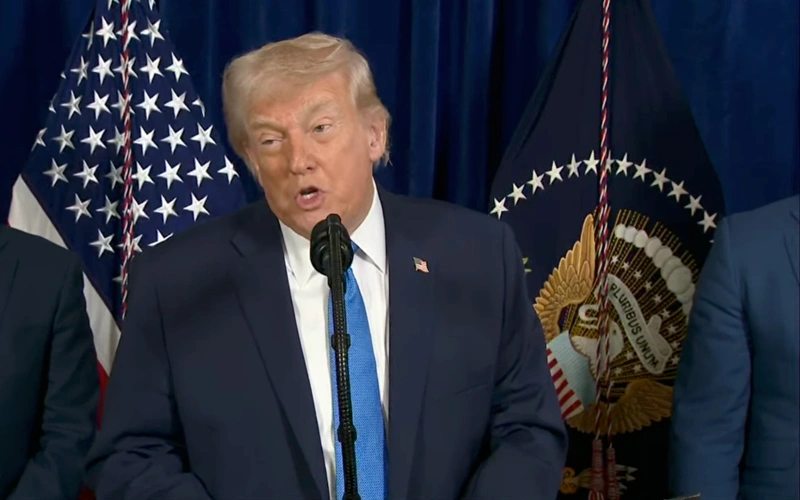
US President Donald Trump said Washington would temporarily “run” Venezuela following the reported capture of President Nicolás Maduro, describing the move as necessary to ensure what he called a “safe, proper, and judicious transition” for the country.
Speaking from Mar-a-Lago on Saturday, Trump framed the announcement as an extraordinary but limited step aimed at preventing further instability in Venezuela, which has faced years of political turmoil, economic collapse, and international isolation. He did not provide details on how the United States would administer the country or which institutions would be involved, nor did he outline a timeline for how long US oversight would last.
Trump said the goal was to avoid “the mistakes of the past,” arguing that Venezuela required temporary external management to stabilise its political and economic systems before power could be handed back to Venezuelans. “This is about order, security, and transition,” Trump said, adding that the US would act “judiciously” and with international interests in mind.
The comments followed Trump’s social media post showing an image of Maduro in apparent US custody aboard a naval ship. The White House has not released official documentation or operational details confirming the circumstances of Maduro’s reported capture, and US agencies have so far declined to comment publicly on the specifics.
International reaction was swift. Some governments expressed alarm, warning that any direct US administration of another sovereign nation would raise serious legal and diplomatic questions under international law. Others called for clarity, transparency, and multilateral involvement, stressing that any political transition in Venezuela should ultimately be led by Venezuelans themselves.
Analysts say Trump’s remarks mark a dramatic escalation in rhetoric and, potentially, US involvement in Latin America. Even as questions remain over what “running” Venezuela would entail in practice, the statement has already intensified scrutiny of US foreign policy intentions and raised concerns about regional stability.
For consumers and observers, the key issue remains uncertainty: how such a transition would be implemented, who would oversee it, and whether international institutions or regional partners would play a role if the situation continues to unfold.